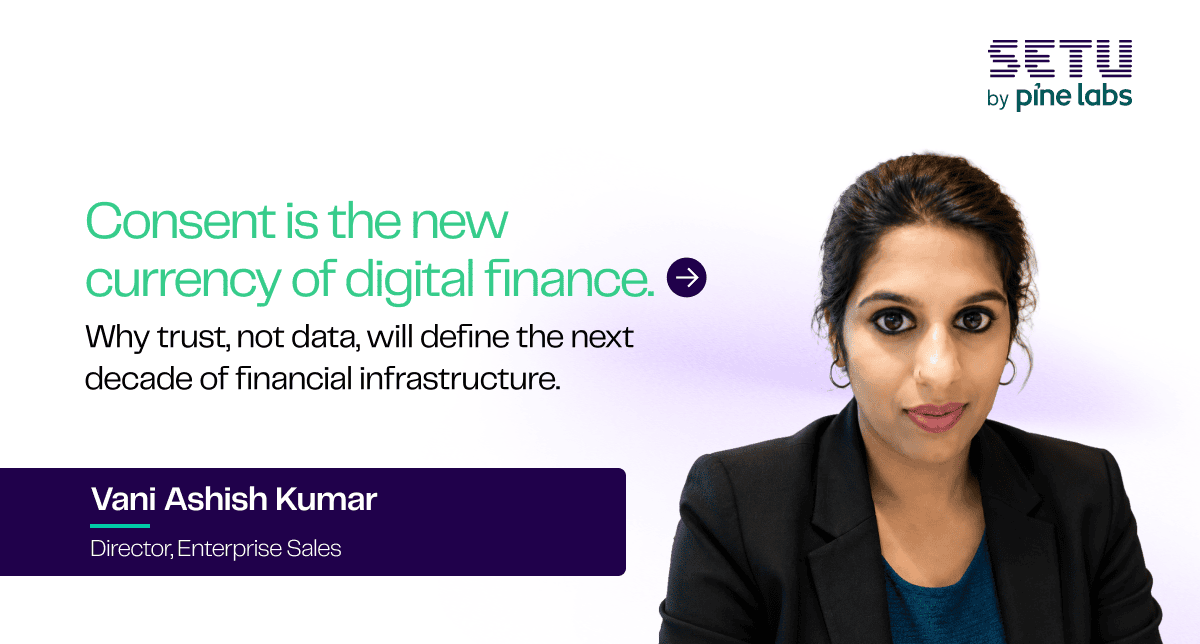
Consent Is the New Currency of Digital Finance

Vani Ashish Kumar
Director, Enterprise Sales
24 Aug 2026
For years, digital finance ran on one assumption: more data means better outcomes. Faster onboarding, sharper credit decisions, stronger fraud detection, more personalized products — all of it, the industry believed, followed naturally from collecting more. Data wasn't just useful. It was treated as the engine of progress itself. That assumption is no longer sufficient, and it is worth being precise about why. The question worth asking is no longer how much data can we collect. It's how responsibly can we access, govern, and use it. That distinction sounds subtle. It isn't. One question is about volume. The other is about legitimacy — and legitimacy, not volume, is what customers and regulators are increasingly using to judge financial institutions. This is not simply a compliance shift. It is a strategic one, and it will separate the institutions that lead the next decade from the ones that spend it playing catch-up.
The End of Unlimited Collection India has built one of the most sophisticated digital public infrastructures in the world, and it is worth naming the pieces individually before looking at what they add up to. UPI transformed how payments move. Aadhaar simplified identity verification at a scale few countries can match. The Account Aggregator framework introduced a secure, standardized structure for permissioned financial data sharing. The Digital Personal Data Protection Act has now given that structure legal weight, turning what was largely a technical and institutional norm into an enforceable right. Viewed individually, each of these is a landmark achievement. Viewed together, they point to something considerably larger: financial services are moving from institution-centric data ownership toward customer-centric data control. That is a shift in power, not merely a shift in process. For most of the industry's history, data sat with the institution that collected it, governed largely by that institution's own policies and discretion. Increasingly, customers expect to decide who touches their information, why it is being used, how long it can be retained, and when access should end. This is not a preference at the margins. It is becoming the baseline expectation. Financial institutions that continue to treat consent as a legal disclaimer — buried inside lengthy terms and conditions that no one reads — are going to fall behind. They will fall behind on customer expectations first. Regulatory consequences will follow second. The order matters, because it means the institutions waiting for regulation to force the issue are already late.
Open Finance Was Never About Moving Data There is a common misreading of open banking and open finance: that they are primarily about making data portable — about building pipes that let information flow more freely between institutions. That reading misses the point entirely. Open finance is not about making data portable. It is about making permission portable. The real innovation behind India's Account Aggregator framework is not the movement of financial information from one institution to another. That movement, on its own, is not new — data has always moved between institutions in various forms. What is new is the creation of a trusted, standardized mechanism through which customers can securely and explicitly authorize that movement, on their own terms, for a specific purpose, for a specific duration. That distinction changes what becomes possible. Without robust consent infrastructure, open finance is simply another data-sharing exercise — one that raises privacy concerns and increases operational risk without necessarily creating new value for the customer whose data is being shared. With robust consent, entirely new categories of business models become viable. A lender can access verified financial information only after the customer has explicitly granted permission for that specific purpose. An investment platform can consolidate portfolios across multiple institutions without compromising the customer's underlying privacy. Insurance products can be personalized using financial insights the customer has actively approved sharing, rather than data quietly inferred or purchased from third parties. In each of these cases, the interaction is governed by explicit authorization rather than by implicit assumption. That is not a small technical detail. It is the entire mechanism that makes these ecosystems scalable — trustworthy enough for customers to participate in repeatedly, and durable enough for institutions to build long-term products on top of.
DPDP Is a Business Question, Not Just a Legal One Whenever new privacy regulation emerges, the industry's first instinct is almost always compliance-oriented. What do we need to change? How do we avoid penalties? Those are necessary questions to ask — no serious institution can ignore them — but they are not the most important ones, and treating them as the endpoint of the conversation is a strategic mistake. The more important question is this: how do we use privacy to strengthen customer trust, rather than simply survive the regulatory requirement? The DPDP Act challenges organizations to rethink every stage of the customer journey — from onboarding and initial data collection, through storage and processing, to sharing and, eventually, deletion. That is a wide-reaching mandate, and it touches functions across an organization that rarely coordinate closely: product, legal, engineering, risk, and customer experience all have a stake in getting it right. Companies that engage with this shift early — rather than treating it as a checklist to clear before a deadline — stand to gain more than regulatory readiness. They stand to earn customer confidence, and in financial services, confidence compounds over time in a way few other assets do. Once lost, it is extraordinarily difficult to rebuild; customers who feel their trust was misused rarely give a second chance easily. Privacy, viewed through that lens, should not be treated as a compliance cost to be minimized. It should be treated as an investment in the durability of the customer relationship itself.
Digital Lending Needs Permission, Not More Data Few sectors illustrate this transformation as clearly as digital lending. The industry has spent years optimizing underwriting models by expanding the range of customer signals fed into them — bank statements, employment records, GST information, credit bureau reports, digital footprints, and a growing list of alternative data sources now routinely inform credit decisions. Yet the terms of competition in this space are changing, and it is worth being specific about how. The competitive advantage in lending is no longer determined primarily by how many data sources a lender can integrate into its underwriting stack. It is increasingly determined by how transparently those data sources are accessed and used. Customers are asking clearer, more pointed questions than they used to. Why is this particular piece of information required? How will providing it actually improve my application or my terms? Who else will have access to it once I provide it? Can I revoke that permission later, and what happens if I do? These questions are becoming as central to the customer's decision to proceed as approval rates or turnaround times traditionally have been. The lenders who can answer these questions clearly, consistently, and without hedging will build stronger, more durable customer relationships than those who simply ask for the broadest possible access and hope the customer doesn't push back. That gap — between institutions that explain and institutions that merely request — is where competitive separation is starting to happen. ** Consent Should Be Invisible to Friction, Never Invisible to the Customer** One of the harder design challenges in financial products is balancing regulatory compliance with a usable customer experience. Nobody wants customers navigating five screens of dense legal language before they can complete a simple transaction. That kind of friction doesn't create better-informed customers — it creates customers who click through without reading anything, which defeats the purpose entirely. At the same time, meaningful consent cannot be reduced to a single generic checkbox either. A checkbox that says "I agree" to a bundle of unrelated data uses is not meaningful consent, even if it satisfies a narrow legal requirement. The answer lies in intelligent consent design — consent that is contextual, purpose-specific, time-bound, and easy to withdraw. Customers should understand, at the moment it matters, exactly what they are authorizing, why it benefits them specifically, and how they remain in control of that authorization going forward. When this is designed well, consent creates confidence rather than friction. In fact, the best consent experiences tend to be the ones customers barely notice at all — not because the consent step was skipped, but because it was clear, intuitive, and transparent enough that it didn't feel like an obstacle.
Consent Becomes Infrastructure Over the next decade, consent management is likely to evolve from a product feature into a foundational layer of digital finance — sitting alongside identity verification, payments, fraud prevention, and risk management as core infrastructure rather than a bolt-on capability. It will no longer be viewed as something a product team adds to satisfy a legal requirement. It will be viewed as infrastructure that the rest of the system depends on. Organizations will invest in consent orchestration, real-time preference management, immutable audit trails, lifecycle governance, and privacy-by-design architectures — not simply because regulation requires it, but because interconnected ecosystems require it structurally in order to function. This evolution looks close to inevitable. As financial institutions collaborate across increasingly interconnected networks — sharing data, building on shared infrastructure, participating in the same ecosystems — trust cannot depend on bilateral agreements negotiated institution by institution. It has to be embedded into the technology itself, so that trust scales at the same pace the ecosystem does. Consent is the mechanism that makes that scaling possible.
The Leadership Imperative The financial institutions that define the next decade are unlikely to be the ones with the largest data repositories. They are more likely to be the organizations that customers trust with access to their data in the first place. That distinction is profound, even though it is easy to state simply. One of these — the size of a data repository — is built primarily through technology and scale. The other — trust — is earned through transparency, accountability, and responsible governance, sustained consistently over time rather than demonstrated once. Every product leader, compliance officer, technology architect, and CEO in this industry should sit with a version of the same question: if our customers could see every decision we make with their data, would they still choose to trust us? That is an uncomfortable question to ask honestly, and that discomfort is precisely why it is the right one to ask. That is the standard by which digital finance will increasingly be judged. Consent management is no longer a compliance function tucked away in a legal team, nor is it simply a product capability to be shipped and forgotten. It is a strategic differentiator. In the coming years, the most successful financial institutions will not be the ones that collected the most data. They will be the ones that built ecosystems where customers willingly chose to share their data — because those customers understood the value being created for them, and trusted the organizations receiving it to honor that exchange. Data may fuel innovation in digital finance. But consent is what makes that innovation sustainable.