How You Pay Is Who You Are

Kaushal Mohan
Principal Product Manager
24 Aug 2026
UPI is nearly ten years old, and roughly 80% of a modern Indian bank statement is now UPI. Not NEFT. Not cheques. Not the tidy monthly salary credit most underwriting models were built around. Read that 80% well, and a bank statement starts reading like a diary of how someone actually lives. Read it badly — as most legacy parsing tools still do, tagging every UPI line as a flat "Transfer/Others" — and you are making a lending decision on one-fifth of the person in front of you.
Here is what the other 80% looks like once you stop flattening it.
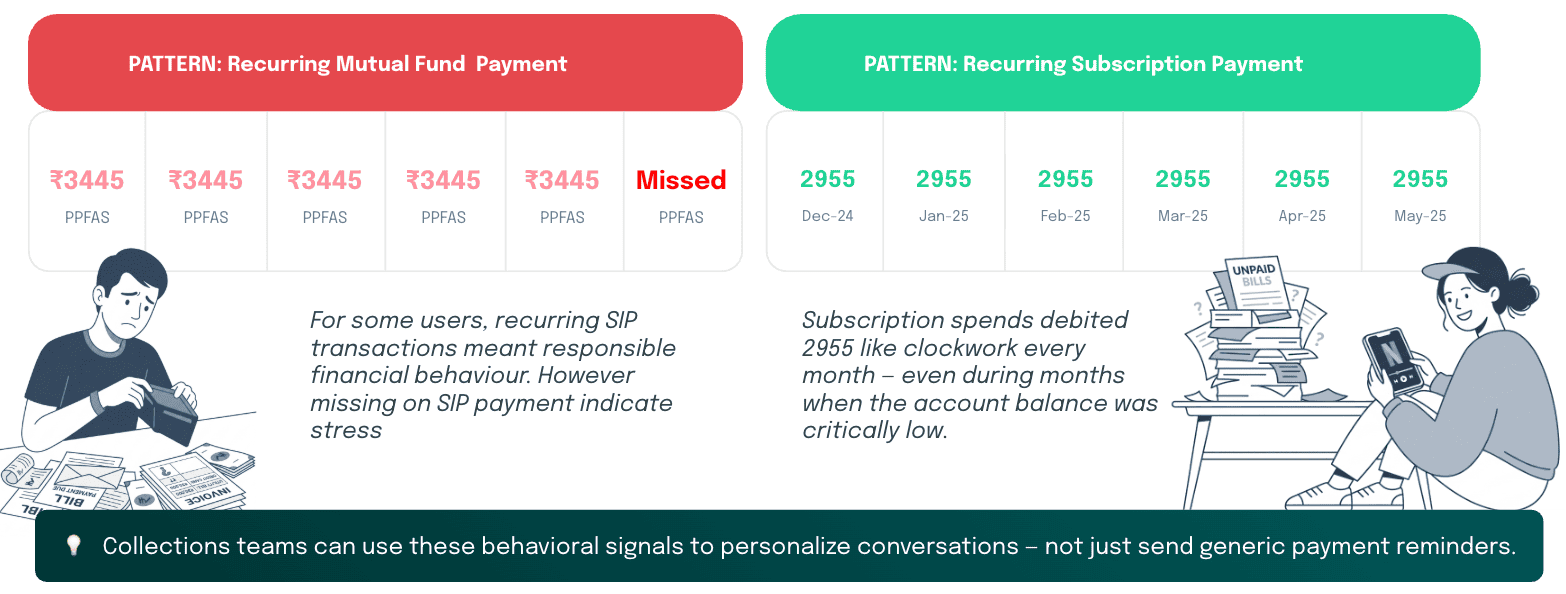 [Exhibit 1 — monthly trend]
Every month, without fail, ₹3,445 went out toward a mutual fund SIP. Until the sixth month, when it didn't. In that same window, a ₹2,955 subscription bundle covering Netflix, Hotstar and Zee5 debited like clockwork — even when the balance was critically low.
The borrower didn't stop paying. He stopped paying selectively. Investment cut first, entertainment left alone. That is not something a missed-EMI flag or a bureau refresh will ever tell you. It is a fact about how this specific person prioritises money under pressure, and it was sitting in plain text in his statement the whole time.
What the bureau was never built to answer Most lending decisions in India are still made almost entirely on bureau scores, pre-approved lists and scrubbing datasets. Genuinely useful signals — but built to answer a narrower question than most lenders now ask of them. Bureau data works well for people who have already borrowed once: the existing-to-credit. It has very little to say about the roughly 90% of India's workforce that is informal, of whom only 12–15% hold what the Periodic Labour Force Survey would call a formal job. That is not a data quality problem. A bureau file, by design, is a record of debt, not of income.
That's where payment behaviour does something a bureau pull structurally can't. Take a freelance consultant getting paid through UPI instead of a salary slip. Look at this narration:
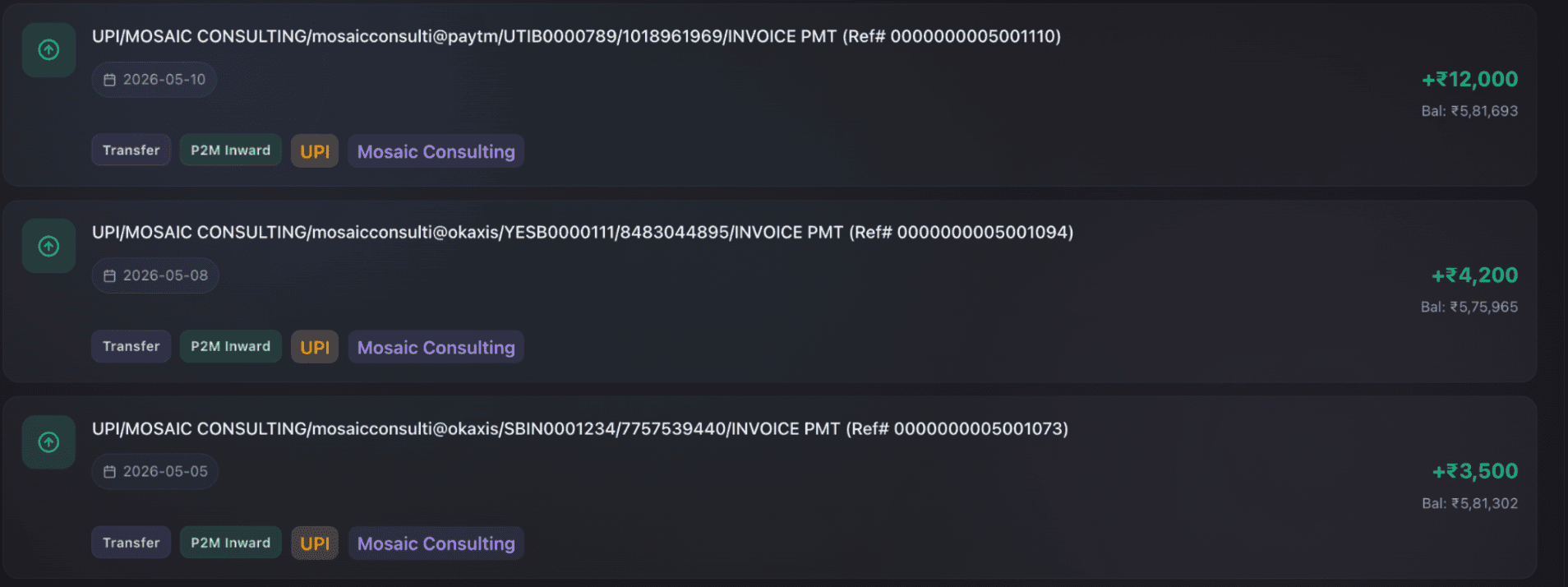 [Exhibit 2 — invoice narrations]
Three payments, one counterparty, one month. ₹12,000, then ₹3,500, then ₹4,200 — arriving through three different UPI handles and three different banks, each narrated "INVOICE PMT."
No fixed amount. No fixed date. Nothing a salary-matching rule would recognise. Read as payment behaviour rather than as three unrelated transfers, it is obviously a real, recurring client relationship: freelance income, paid on delivery, from a company that exists.
That is the earning pattern for a huge share of India's workforce. It is exactly what a bureau file — or a rules engine hunting for a monthly salary credit — is built to miss.
One statement, one reader This is where the bank statement gets useful beyond underwriting, and it is the part most institutions still miss entirely. A statement is touched at every stage of a loan's life: onboarding, decisioning, underwriting, collections, recovery, cross-sell. In most organisations, only one team is actually reading it closely. The same signals that price a loan can flag it before it goes bad, and sell the next product after it has been repaid. A missed SIP after five clean months is a documented, timestamped early warning, not a hunch.
And the same narrations that reveal stress reveal appetite.
 [Exhibit 3 — merchant narration]
A borrower routing ₹19,388 through Goibibo is not a demographic guess. It is a merchant-tagged, MCC-coded fact — and a travel-card lead. Someone sending ₹5,000 a month into an HDFC mutual fund SIP is a wealth-platform lead. No survey required. It is already sitting in six months of statements, in narrations most tools read as noise.
This is the thesis behind SignalIQ, what we have been building at Setu: an AI reader for the modern bank statement, built on Pine Labs' UPI and BBPS payment rails, so that a UPI narration resolves to an actual merchant, category, employer or client instead of "Transfer/Others." Not a replacement for the bureau. A complement to it, reading the 80% of the statement most tools still cannot see.
Global Fintech Fest is a few weeks away, and every conversation there will circle back to some version of the same question: how do the next few hundred million borrowers actually get served?
I don't think the answer is a better bureau. I think it is already sitting in their phones — in the UPI trail of a hundred small, unremarkable payments a month. The SIP that didn't go through. The subscription that quietly still did. And the invoice payment from a client called Mosaic Consulting that nobody's rule engine would have detected.