Article Overview:
UPI transaction data is reshaping credit underwriting in India because it shows lenders a borrower's real, current financial behaviour, income, recurring obligations, and spending stability, rather than only a historical bureau score. With over a billion UPI transactions processed daily across India, this data gives underwriters visibility into thin-file and new-to-credit borrowers who bureau-only scoring cannot assess reliably. Traditional underwriting relies on static documents and manual review, which is slow and misses patterns that only show up across months of transaction history. Reading UPI narrations, recurring transfers and cash flow trends directly from bank statements lets lenders assess repayment capacity more accurately and faster. SignalIQ, Setu's AI-powered bank statement analyser, is built specifically to decode this UPI-heavy transaction data that legacy parsers typically miss, turning it into structured credit signals lenders can act on.
How UPI Transaction Data Is Reshaping Credit Underwriting in India
India now processes over a billion UPI transactions a day, and for lenders, that data is quietly becoming one of the richest sources of borrower insight available. Credit underwriting has traditionally leaned on bureau scores and static documents, but those don't capture what a borrower's account activity shows in real time. At Setu, we work with lenders who are rethinking underwriting around this transaction data, not replacing bureau scores, but filling in what they miss. Here's what's changing, and why it matters.
What Is Credit Underwriting?
Credit underwriting is how a lender assesses a borrower's risk and decides whether, and on what terms, to approve a loan. Underwriting traditionally combines a credit bureau score, income documents and a manual review of the application. It answers one question: is this borrower likely to repay? The inputs feeding that answer are what's changing. Loan underwriting teams increasingly pull in transaction-level data, particularly UPI activity, to get a more current picture than a bureau score alone can offer.
Why Traditional Credit Underwriting Falls Short for Many Indian Borrowers
The Limits of Bureau-Only Credit Scoring
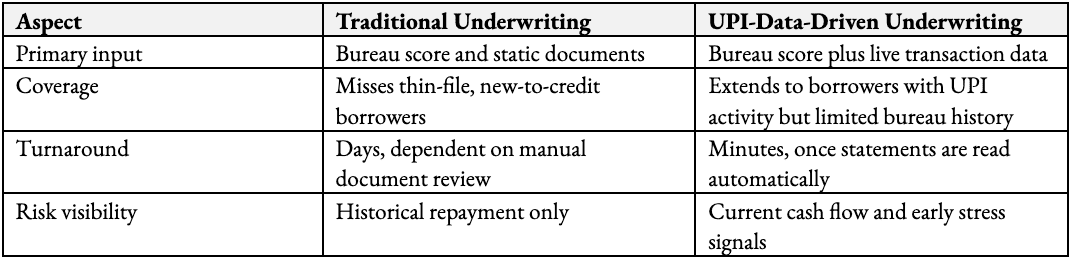
A bureau score reflects past repayment history on formal credit products. It says little about a gig worker, small merchant, or first-time borrower whose income is real but doesn't show up as a credit history. Understanding what is underwriting in banking today means recognising that bureau data alone leaves a large share of creditworthy borrowers unscored or under-scored.
Why Manual Underwriting Doesn't Scale
Even when lenders do request bank statements, manually reviewing months of transactions per applicant is slow and inconsistent between reviewers. It's also poorly suited to reading UPI narrations, which are often abbreviated, inconsistent, or app-specific, making them easy for a human reviewer and a legacy parser to misclassify or skip entirely.
What UPI Transaction Data Reveals That Bureau Data Can't
A borrower's UPI transaction history shows patterns a bureau score cannot:
- Actual income frequency and consistency, not just a declared salary figure
- Recurring outflows like rent, SIPs, and informal loan repayments
- Spending stability and cash flow volatility month-to-month
- Early stress signals, such as rising small-value borrowing between salary credits This is closer to alternative credit data than traditional scoring, and it's precisely the kind of signal a credit scoring model built only on bureau inputs cannot see.
How Lenders Are Using UPI Transaction History in Underwriting
Lenders folding UPI data into underwriting typically use it to support, not replace, existing credit risk assessment processes:
- Verifying declared income against actual account inflows
- Scoring thin-file and new-to-credit borrowers who lack sufficient bureau history
- Flagging early repayment stress before it shows up as a missed EMI
- Speeding up approvals for existing customers by reading recent transaction data instead of requesting fresh documents Also Read: Reimagining credit in India: Alternative data and the next credit revolution
Automated vs Traditional Credit Underwriting
How SignalIQ Works and Helps With This
This is where SignalIQ, Setu's AI-powered bank statement analyser, fits in. Roughly 80% of a typical Indian bank statement today is UPI narrations that legacy parsers cannot reliably read, which means most bank statement analysers are working with an incomplete picture before underwriting even begins. SignalIQ is built to read that UPI-heavy data directly. Decodes UPI narrations that legacy parsers file under generic categories like "Transfer/Others" Turns raw transaction data into structured income, obligation and risk signals Surfaces early cash flow stress signals before they turn into a missed payment Plugs into a lender's existing underwriting workflow via API At Setu, we built SignalIQ because the transaction data lenders need was already there, it just wasn't readable at scale. SignalIQ closes that gap.
Want to see how SignalIQ reads UPI-heavy bank statements for underwriting? Learn More
Conclusion
Credit underwriting in India is shifting from a bureau-first process to one that reads a borrower's actual financial behaviour, and UPI transaction data is the biggest reason why. For thin-file borrowers and lenders trying to underwrite faster without taking on more risk, this data fills a gap that credit scores alone never could. The lenders moving fastest on this aren't replacing their existing underwriting process, they're feeding it better data. Tools built specifically to read UPI-heavy statements, like SignalIQ, make that possible without adding manual review work for credit and risk teams. For more information, feel free to contact our team!