Summary:
India Stack refers to the shared digital public infrastructure, Aadhaar, UPI, DigiLocker, eSign and the Account Aggregator framework, that lets Indians verify identity, move money and share financial data digitally. For lenders, this stack solves a problem bureau data alone cannot: roughly 500 million Indians have a credit bureau footprint, but hundreds of millions more pay rent, utility bills and mobile recharges responsibly with no formal loan history to show for it. India Stack lets lenders read that behaviour directly instead of guessing at it. Account Aggregator brings consented bank statement data into one flow, UPI narrations reveal income and spending patterns bureau scores miss entirely, and DigiLocker plus Aadhaar handle verification in minutes rather than days. This is why Indian lenders now underwrite thin-file and new-to-credit borrowers who would be invisible to bureau-only models elsewhere. The catch is that most parsers still cannot read UPI narrations well, even though narrations make up 80% of a typical bank statement. Setu's SignalIQ was built to close that specific gap, turning raw UPI and bank statement data into underwriting-ready signals for precision underwriting, predictive collections and cross-sell.
The India Stack Advantage: Why Indian Lenders Are Ahead on Data-Driven Credit
Ask a lender in Singapore or the UK how they verify a borrower's income and bank details, and the answer usually involves a document upload, a manual check and a few days of waiting. Ask a lender in India, and the answer is India Stack. Aadhaar, UPI, DigiLocker and the Account Aggregator framework let banks and NBFCs verify identity and pull consented financial data in minutes, not days. This shared digital infrastructure is why Indian lenders can now underwrite borrowers that bureau scores alone would miss entirely, gig workers, small business owners and salaried professionals paid partly through UPI. At Setu, we build the rails that turn this data into credit decisions, and this piece looks at why that advantage exists and where it is headed.
What Is India Stack?
India Stack is India's set of shared digital public infrastructure for identity, payments and consented data sharing, built as open rails that any bank, NBFC or fintech can build on, rather than one company's product. It works because the layers connect: Aadhaar establishes who a person is, UPI moves money instantly, DigiLocker and eSign handle documents and signatures, and the Account Aggregator framework lets people share their own financial data with lenders on their own terms. Read more on how this shift began in India, a fintech miracle.
The Four Layers That Make India Stack Work for Credit
- Presenceless layer: Aadhaar-based verification, so a lender confirms identity without a branch visit.
- Paperless layer: DigiLocker and the eSign gateway replace physical documents and wet signatures.
- Cashless layer: UPI, now the default rail for salaries, rent and daily spends, generating a rich transaction trail.
- Consent layer: Account Aggregator lets a borrower share bank statements only with explicit, revocable consent. Each layer alone helps. Together, they let a lender build a fuller credit picture in minutes, using data borrowers already generate every day.
Where Bureau-Only Underwriting Falls Short
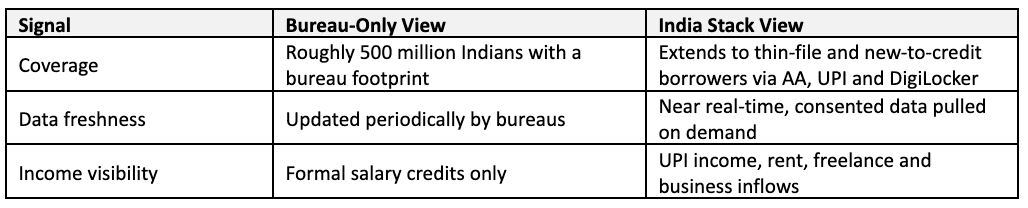
Credit bureau scores remain a useful starting point, but they were never built to capture how most Indians actually earn and spend today. A large share of India's population has no meaningful bureau footprint, not because they are risky, but because they have never taken a formal loan. Read more in Reimagining credit in India.
How Indian Lenders Turn India Stack Data Into Credit Decisions
Account Aggregator bank statements, pulled with consent instead of PDF uploads UPI narrations, decoded for salary credits, rent and recurring bills that legacy parsers often miss BBPS utility and bill payment history, a proxy for financial discipline GST and ITR data, for MSME and self-employed underwriting None of these signals is new on its own. What India Stack changes is the speed and consent structure behind pulling them together, so a lender sees a rounder picture of repayment capacity before disbursing, not just after a default.
What Is Account Aggregator and How Does Consent Work?
Account Aggregator (AA) is an RBI-regulated framework that lets a borrower consent to share specific financial data, such as bank statements or GST filings, directly with a lender through a licensed intermediary, without emailing PDFs or screen-sharing net banking. The borrower approves what data, for how long and with whom, through a consent artefact they can revoke at any time. For lenders, this means fewer drop-offs at document upload, since the data arrives structured and verified rather than as a scanned statement to be read manually. See how this consent flow was designed in Bridging the data gap.
How SignalIQ Works and Helps With This
India Stack solves access to data. SignalIQ solves what happens next. SignalIQ is an AI-powered bank statement analyser with a UPI Intelligence layer that reads transaction data and turns it into useful insights about a customer's income, obligations and financial behaviour. Roughly 80% of a modern Indian bank statement is now UPI narrations, and most legacy parsers cannot read them. SignalIQ decodes these narrations line by line, turning cryptic transaction strings into structured income, obligation and behaviour signals.
- Precision underwriting: granular categorisation surfaces salary, rent, freelance and business income that legacy parsers group as "miscellaneous transfer"
- Predictive collections: early warning signals, like a falling balance ahead of an EMI date, flag stress before a default, not after
- Personalised cross-sell: real spending behaviour, not assumptions, shapes which product a customer is actually offered This is part of the same intelligence layer behind Setu Data and Insights, which categorises transactions across 70+ granular categories, against the 15 to 20 typical of industry-standard analysers, at 95%+ precision and recall. Lenders using this depth of enrichment have safely grown approvals by 10 to 15%.
Want to see how SignalIQ reads UPI narrations for underwriting-ready signals? Get in Touch
Conclusion
India Stack gives Indian lenders something most markets do not have: shared, consented rails for identity, payments and financial data. Aadhaar, UPI, DigiLocker and Account Aggregator together let banks and NBFCs see a borrower's real financial behaviour, not just their bureau history, which is why India now underwrites thin-file customers that would be invisible elsewhere. The remaining gap is reading that data well, since UPI narrations alone make up roughly 80% of most modern bank statements today. SignalIQ closes this gap, turning raw transaction data into underwriting-ready signals for precision underwriting, predictive collections and personalised cross-sell across the lending lifecycle. Explore SignalIQ to see how it fits your lending stack.