Article Overview:#
Bank statement analysis is the process of reading a borrower’s bank statement and converting raw transaction lines into structured credit signals: income, obligations, balance behaviour and risk flags. Lenders use it to verify income, calculate FOIR, and judge repayment capacity, particularly where bureau history is thin or missing. A typical report covers monthly average balance, salary or business inflows, EMI and bounce history, and recurring obligations. It matters more now because most Indian retail payments have moved to UPI. Setu estimates that roughly 80% of a modern Indian bank statement is unstructured UPI narration, which older parsers file as generic transfers. That gap distorts both sides of FOIR at once: income reads low and obligations go missing. Techniques range from manual review, through rule-based parsing and OCR, to AI categorisation that reads narration semantically and tags recurrence. This guide covers what bank statement analysis is, what the report contains, the techniques lenders use, where credit underwriting depends on it, and how SignalIQ reads the full statement.
What Is Bank Statement Analysis and Why It Matters in Modern Lending#
A bank statement is the only document a lender gets that records what a borrower actually did with money, rather than what they declared. Bank statement analysis is how that record becomes a credit decision. It used to be a clerical step. An analyst opened a PDF, totalled the salary credits, listed the EMIs, checked for bounces, and moved on. That worked when income arrived as one labelled NEFT credit a month. It stopped working when India moved to UPI, and the analysis of bank statement data became a language problem rather than an arithmetic one.
What is bank statement analysis?#
It is the structured reading of a bank statement to extract income, obligations, balance patterns and risk signals so a lender can assess repayment capacity from observed cash flow rather than declared figures.
- Inputs are usually 6 to 12 months of statements, pulled with consent or uploaded by the borrower
- Every transaction line is classified: income, obligation, transfer, spend or charge
- Recurrence matters as much as amount, since a monthly ₹25,000 credit and a one-off ₹25,000 credit mean different things
- Output is a structured dataset, not a summary, so it can feed a scorecard or a policy rule directly This is why bank statement analysis in india has become a data engineering problem, handled increasingly through consented flows via Account Aggregator.
What does a bank statement analysis report contain?#
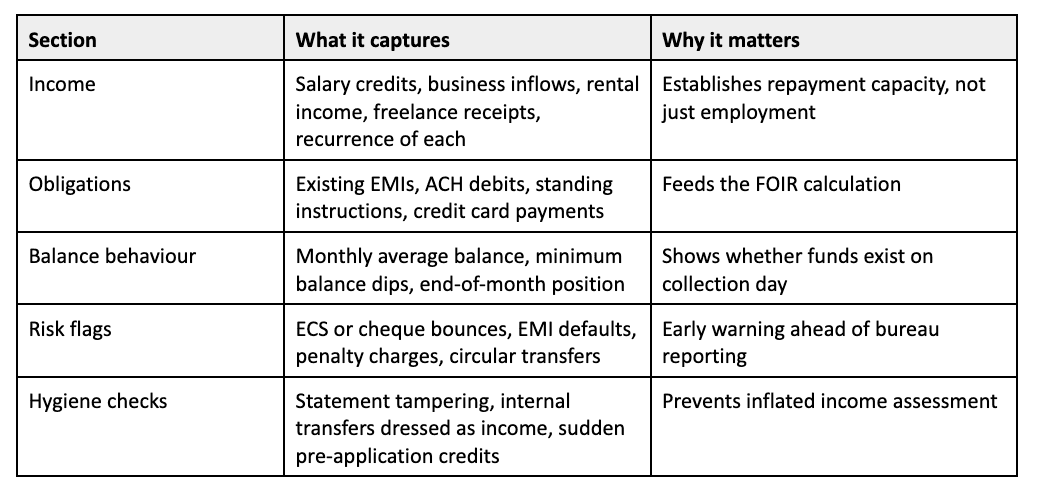
A bank statement analysis report is organised around five questions an underwriter needs answered.
Why it matters in modern lending#
Three shifts have pushed the statement from supporting document to primary evidence.
- Income has fragmented. Salary, rent, freelance work and business receipts now arrive over UPI, often to the same account, so a single salary line no longer describes earnings
- Bureau coverage lags behind borrower demand. New-to-credit and thin-file applicants have behaviour but no history, which is the case for alternative data in credit decisions.
- Regulatory expectations have tightened. Lenders must assess income before approval, which means income missed by a parser is a documented gap, not just a lost approval The practical result: bank statement analysis for loan decisions now determines both who gets approved and who gets wrongly declined. A borrower whose rent income reads as TRANSFER/OTHERS looks unserviceable on paper and perfectly serviceable in reality.
Bank statement analysis techniques and methods lenders use#
The four bank statement analysis techniques in use today sit on a spectrum of how much narration they can actually read.
- Manual review: an analyst reads the PDF. Accurate on clean salaried files, slow, and inconsistent across reviewers
- Rule-based parsing: regex and keyword rules map narration to categories. Breaks on any format it has not seen, and UPI strings are effectively unbounded in format
- OCR and template extraction: solves reading scanned or password-protected statements, but does not solve meaning. A correctly extracted line can still be miscategorised
- AI categorisation: models read narration semantically, resolve the counterparty, and tag recurrence, which is what unstructured UPI data requires The gap between these bank statement analysis methods is not speed. It is how much of the statement each one can see.
What is credit underwriting, and where the statement fit?#
The credit underwriting meaning most lenders work with is straightforward: assessing whether a borrower can and will repay, then pricing that risk. A bureau score answers the will. Cash flow answers the can. Inside the credit underwriting process, the statement feeds FOIR, the ratio of fixed obligations to income. Both halves of that ratio come from the same document, which is why partial reading is dangerous in both directions. Unread income inflates FOIR and declines a good borrower. Unread EMIs deflate it and approve a stretched one. A statement read at 20% coverage does not produce a cautious decision; it produces a random one.
How SignalIQ works and helps with this situation?#
SignalIQ is Setu’s bank statement analyser, built for the statement Indian lenders actually receive, where most of the narration is UPI. It reads the full transaction set and returns structured credit insight across three points in the lifecycle.
- Precision underwriting: granular categorisation separates genuine income from internal transfers, and captures secondary income such as rent, freelance payments and business inflows with recurrence attached, so capacity is assessed on total income rather than salary alone
- Predictive collections: pre-delinquency patterns such as low-balance stress, bounce charges and penalties surface early, along with the window in the month when funds are actually present
- Personalised cross-sell: offers are matched to observed spending behaviour instead of a segment assumption For thin-file applicants the effect is direct. Consistent rent payments, utilities, SIPs and an absence of bounces become evidence where a bureau file has none. SignalIQ sits on Setu’s data and insights stack, alongside work on transaction categorisation engines.
Find out how much of your borrowers’ income your current parser never sees.#
Conclusion#
Bank statement analysis is no longer a document check that happens before the real decision. It is the decision, because cash flow is where income, obligations and early stress all show up first. The quality of that reading now sets the ceiling on how accurately any lender can underwrite retail credit in India. If most of a statement lands under other, the resulting FOIR is a guess wearing a decimal point. SignalIQ reads the whole transaction set, UPI narration included, and returns income, obligation and risk signals a credit team can defend in review. See SignalIQ for the detail, or contact us to talk it through.